
5 Findings From the Potty Training Research That Might Surprise You
For something that every child goes through, toilet training is surprisingly controversial.
There's so much conflicting advice that it's no wonder many parents feel confused, so this article is about understanding what the research actually tells us, so parents can make informed decisions.

Some people believe introducing a potty early is beneficial. Others worry it could harm bladder and bowel development.
I
f you'd like to understand where those concerns came from, I've explored the history behind them in my previous article.
But what does the evidence actually say?
When you step back and look across the evidence, some clear patterns emerge. Some challenge long-held assumptions. Others suggest we've been asking the wrong questions about potty training altogether.
1. Babies Are More Capable Than We've Been Led To Believe
For decades, babies were thought to have little awareness of their bladder or bowels. The prevailing view was that urination was almost entirely reflexive, and that meaningful toilet learning couldn't begin until much later in childhood.
The research tells a different story.
One of the landmark studies in this field examined healthy babies from birth to 10 months of age. Rather than eliminating completely at random, the researchers found that:
Babies' bladders filled and emptied in organised patterns¹
There were signs of cortical arousal immediately before babies urinated¹
Urination did not occur during deep sleep¹
Together, these findings suggest that bladder function in infancy is far more sophisticated than previously believed. Rather than starting from scratch, babies are born with many of the building blocks needed for bladder control. Even newborn babies show signs that their brains are responding as the bladder fills.¹
Researchers have also explored whether babies communicate their need to wee or poo.
In one study, around 90% of parents reported recognising elimination signals before their baby's first birthday, including changes in facial expression, body movements and vocalisations.²
So what does this all mean?
It doesn't mean babies have adult-style bladder control.
But it does suggest that bladder control doesn't suddenly appear during toddlerhood—it develops gradually from birth. Rather than simply having their toileting managed for them, babies can play an active role in the very earliest stages of learning about their bladder and bowels.
2. Modern "Readiness" Advice Rests On… Not Much
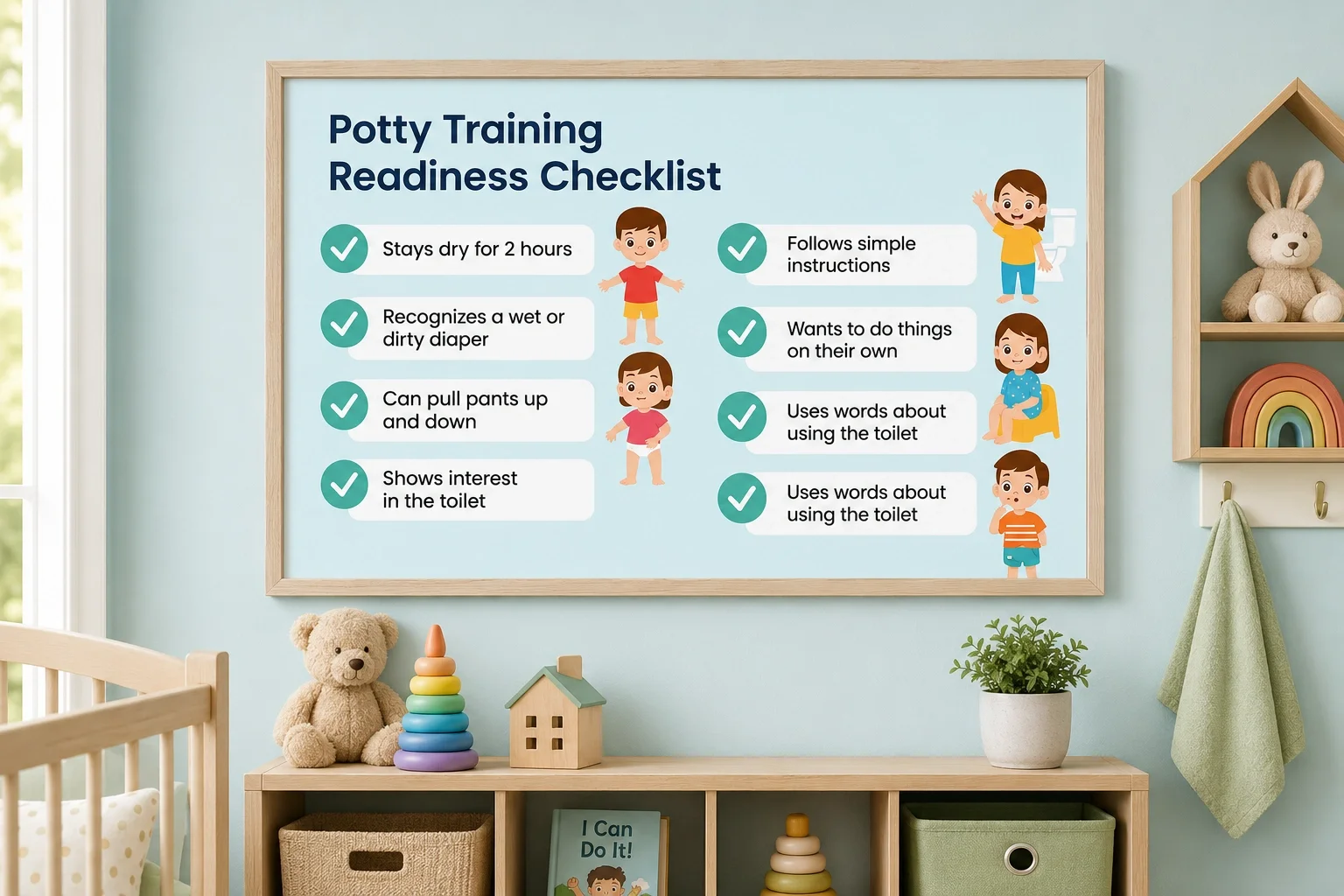
If you've ever looked into potty training, you've probably come across the idea of readiness.
Wait until your child shows the right signs. They'll tell you when they're ready.
It's such a widely repeated message that most parents naturally assume it's based on well-established science.
But when you look at the evidence, it's much less clear than many parents realise.
In 2012, researchers reviewed the scientific literature on toilet training readiness. They identified 21 different readiness signs, yet found remarkably little agreement about which signs mattered, how many were needed, or whether they reliably predicted successful toilet learning.³ In other words, there was no universally accepted definition of what a "ready" child actually looks like.
So where did this idea of "readiness" come from? I've explored its history in my previous article.
The important message is this:
The confidence with which readiness is presented isn't matched by the strength of the evidence.
3. Earlier Toilet Learning Can Support Healthy Bladder Development
One of the clearest patterns to emerge from the research is that children who begin toilet learning earlier also tend to achieve bladder control earlier.
Large studies from the UK, Taiwan and Thailand have all reported the same finding, with earlier toilet learning associated with earlier daytime dryness, earlier nighttime dryness and lower rates of persistent wetting.⁴˒⁵˒⁶
But earlier dryness is only part of the picture. The real question is whether it comes at the expense of healthy bladder and bowel development. And the evidence suggests it doesn't.
Studies from Vietnam and Thailand found that children who began toilet learning earlier showed healthy bladder function and normal weeing patterns throughout infancy and early childhood.⁷˒⁶
In Vietnam, researchers also observed increasingly efficient bladder emptying during the first year of life, with very little urine remaining in the bladder after weeing by around nine months of age.⁷
Some researchers have argued that bladder control is not simply something children grow into—it is also shaped by the habits they develop as they learn to use the toilet, and that healthy bladder habits develop through repeated opportunities to empty the bladder normally during childhood.⁹˒¹⁰
Overall, the evidence doesn't just suggest that earlier toilet learning leads to earlier continence—it suggests that earlier continence is achieved alongside healthy bladder development.
This interpretation is increasingly reflected in UK guidance. The latest Institute of Health Visiting guidance recognises that earlier toilet learning can support healthy bladder and bowel development, encouraging parents to view toilet learning as a gradual developmental process rather than something that begins only once a child is considered "ready".¹¹
4. The Problem With Waiting: No Clear Health Benefits
By now, a different question starts to emerge.
If babies are more capable than we once thought...If "readiness" is less evidence-based than many parents realise...And if earlier toilet learning appears compatible with healthy bladder development...
...what happens when toilet learning is delayed?
Despite waiting becoming the default advice in many western countries, there is surprisingly little evidence that delaying toilet learning improves bladder or bowel health.
In fact, several studies have reported the opposite pattern:
Children who started toilet training after 24 months were more likely to experience delayed bladder control and ongoing daytime wetting than children who started between 15 and 24 months⁴
Children who started toilet training after 32 months were more likely to experience urge incontinence than those who started earlier¹²
Children with bedwetting tended to have stopped using daytime nappies later than children who remained dry at night (Li et al., 2020)¹³
Of course, children's development is influenced by many factors, including bowel health, temperament and family circumstances. However, these studies undermine one of the central assumptions behind modern potty training advice that waiting for a child to become older will naturally lead to better bladder and bowel outcomes.
5. Have We Been Asking The Wrong Questions?
The research wasn't just pointing towards when children learn to use the toilet. It was also pointing towards how they learn.
The evidence also highlights the importance of:
Children's bowel health
Their toileting habits
The amount of pressure or conflict surrounding toilet learning
And the overall experience of learning to use the toilet
One important factor is constipation. It has been linked with daytime wetting, urinary urgency, recurrent urinary tract infections and other bladder problems¹⁴
Dr Steve Hodges has been particularly influential in this area. His own research actually found more bladder problems in children toilet trained before 24 months or after 36 months.¹⁴ However, it's important to remember that this study was based on children referred to specialist paediatric urology clinics with bladder and bowel problems, rather than representing the healthy general population.
That distinction matters because, when reading Hodges' work as a whole, it becomes clear that he doesn't just focus on the age toilet learning begins. He repeatedly returns to constipation, bowel health and the overall toileting experience as key factors influencing bladder health.
These broader factors have also been explored elsewhere. One study found that children who became distressed about pooing in the potty or toilet were more likely to experience longer and more difficult toilet learning journeys.¹⁵ Follow-up research suggests that positive, supportive responses can help children move through these challenges more successfully.¹⁶
Similarly, children with ongoing wetting and other bladder problems were more likely to have experienced methods designed to provoke urination, such as encouraging them to "push", turning on running water or making special noises.¹⁰
These studies suggest that healthy toilet learning is shaped by far more than age alone. Children's bowel health, their toileting habits and the overall experience of learning all appear to play an important role.
So what's the biggest takeaway from the evidence?
The question isn't simply:
"When should toilet learning begin?"
It's also:
"What creates the healthiest toilet learning experience?"
Special thanks to Rebecca Mottram, Children's Nurse and Potty Training Expert, who reviewed this article for research accuracy.
References
Yeung, C.K., Godley, M.L., Ho, C.K., Ransley, P.G., Duffy, P.G., Chen, C.N. & Li, A.K.C. (1995). Some new insights into bladder function in infancy. British Journal of Urology, 76(2), 235–240.
Rugolotto, S., Sun, M., Boucke, L. & de Vries, M.W. (2008). Assisted infant toilet training: Is it time for a critical revision?La Pediatria Medica e Chirurgica, 30(5), 233–238.
Kaerts, N., Van Hal, G., Vermandel, A. & Wyndaele, J.J. (2012). Toilet training in healthy children: A review of the literature between 1946 and 2010. Neurourology and Urodynamics, 31(4), 437–442.
Joinson, C., Heron, J., Von Gontard, A., Butler, U., Golding, J. & Emond, A. (2009). A prospective study of age at initiation of toilet training and subsequent daytime bladder control in school-age children. Journal of Developmental & Behavioral Pediatrics, 30(5), 385–393.
Yang, S.S.D., Zhao, L.L., Chang, S.J. & Yang, W.H. (2011). Relationship between age at initiation of toilet training and duration of training, daytime wetting, and urinary tract infection in children. Urological Science, 22(3), 95–97.
Benjasuwantep, B. & Ruangdaraganon, N. (2011). Infant toilet training in Thailand: Starting and completion age and factors determining them. Journal of the Medical Association of Thailand, 94(12), 1441–1446.
Duong, T.H., Jansson, U.B., Holmdahl, G., Sillén, U. & Hellström, A.L. (2010). Development of bladder control in the first year of life in children who are potty trained early. Journal of Pediatric Urology, 6(5), 501–505.
Benjasuwantep, B. (2013). Bladder function in healthy Thai children who started toilet training early.
Bakker, E., Van Gool, J.D., Van Sprundel, M., Van Der Auwera, J.C. & Wyndaele, J.J. (2001). Results of a questionnaire evaluating the effects of different methods of toilet training on achieving bladder control. BJU International, 87(9), 872–877.
Bakker, E., Wyndaele, J.J. & Van Gool, J.D. (2002). Does bladder control develop according to age or toilet training?BJU International, 89(3), 290–294.
Institute of Health Visiting. (2025). Healthy bladder and bowel development in children: Guidance for practitioners. Institute of Health Visiting.
Barone, J.G., Jasutkar, N., Schneider, D. & Tan, J. (2009). Later toilet training is associated with urge incontinence in children. Journal of Pediatric Urology, 5(6), 458–461.
Li, X., Wen, J., Shen, T., Yang, X.Q., Peng, S.X., Wang, X.Z., Xie, H., Wu, X.D. & Du, Y.K. (2020). Disposable diaper overuse is associated with primary enuresis in children. Scientific Reports, 10, 14407.
Hodges, S.J., Richards, K.A., Gorbachinsky, I. & Krane, L.S. (2014). The association of age of toilet training and dysfunctional voiding. Research and Reports in Urology, 6, 127–130.
Taubman, B. (1997). Toilet training and toileting refusal for stool only: A prospective study. Pediatrics, 99(1), 54–58.
Taubman, B., Blum, N.J. & Nemeth, N. (2003). Children who hide while defecating before they have completed toilet training: A prospective study. Archives of Pediatrics & Adolescent Medicine, 157(12), 1190–1192.
